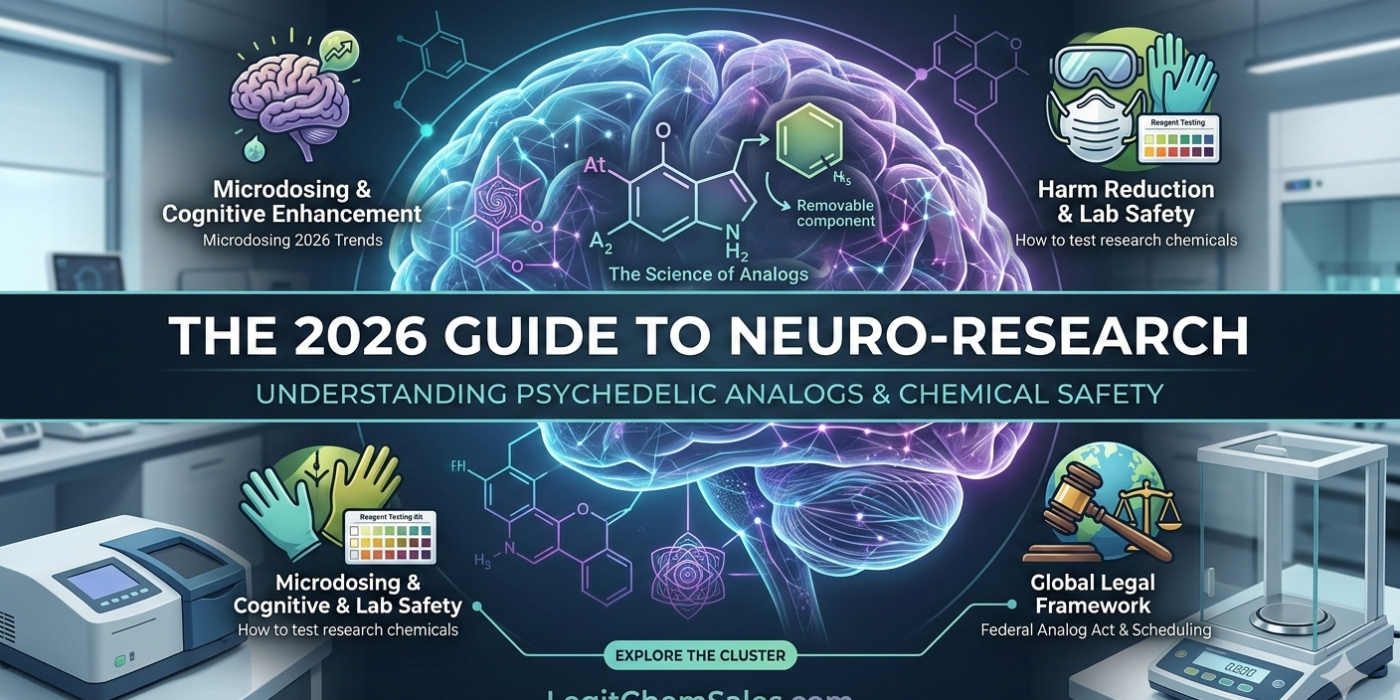
The 2026 Guide to Neuro-Research: Understanding Psychedelic Analogs and Chemical Safety
1. The Science of Analogs
In the modern scientific landscape, the term “Research Chemical Definition” refers to synthetic compounds created specifically for laboratory evaluation and pharmacological study. These substances, often referred to as “analogs,” are molecular cousins to more well-known organic compounds.
An analog is a chemical compound that possesses a structure similar to that of another compound but differs from it in respect to a certain component. Even a single atom substitution—swapping a hydrogen atom for a fluorine atom, for instance—can radically alter the compound’s stability, potency, and receptor affinity. 4-HO-MET
The “Science of Analogs” is the backbone of the “grey market” and legitimate neuro-research alike. Chemists modify the molecular “scaffold” of a known substance to bypass existing legal restrictions or to discover a compound with fewer side effects. For example, in the realm of tryptamines, researchers often look at the 4th or 5th position of the indole ring. By adding an acetoxy group (4-AcO) or a methoxy group (5-MeO), the resulting chemical behaves differently in a laboratory setting.
This granular level of detail is why the Research Chemical Definition is strictly tied to in vitro (test tube) or in vivo (animal model) studies, rather than human consumption. In 2026, the precision of these analogs allows researchers to map the human brain’s receptor sites with unprecedented accuracy, leading to breakthroughs in how we understand serotonin and dopamine pathways.
To understand the Research Chemical Definition, one must understand the “Structure-Activity Relationship” (SAR). SAR is the relationship between the chemical or 3D structure of a molecule and its biological activity. In the case of phenethylamines, adding a bromine atom at the 4th position (creating 2C-B) creates a vastly different binding profile than adding an iodine atom (creating 2C-I). Without these analogs, our understanding of the serotonin system would be decades behind where it is today. Researchers now use computational chemistry to predict these shifts, allowing for the design of “targeted” analogs that hit specific receptor subtypes with surgical precision.
2. The History of the RC Market: From PiHKAL to 2026
The lineage of the modern research chemical market is a fascinating journey of “cat and mouse” between clandestine chemistry and international law. The narrative begins in earnest in the early 1990s with the publication of PiHKAL: A Chemical Love Story by Alexander “Sasha” Shulgin.
This seminal work, followed by TiHKAL, provided the “blueprints” for hundreds of phenethylamines and tryptamines. Shulgin, a former Dow Chemical scientist, documented the synthesis and subjective effects of these compounds, effectively creating a decentralized library for chemists worldwide.
During the early 2000s, the market moved online. Sites like “The Research Chemical Supply” began offering compounds that were not yet scheduled. This led to “Operation Web Tryp” in 2004, a global law enforcement effort that attempted to shut down the first wave of online vendors. However, this only decentralized the market further, moving production from Western labs to massive industrial facilities in China and India. By 2010, the “Mephedrone era” saw the rise of synthetic cathinones, followed closely by the explosion of synthetic cannabinoids like JWH-018.
Entering 2026, the market has evolved from the “Wild West” into a sophisticated, highly technical industry. The chaos of the “Spice” era has been replaced by a focus on high-purity lysergamides and tryptamines. Modern labs now use ultra-high-performance liquid chromatography (UHPLC) and mass spectrometry to ensure purity. The focus has shifted from “legal highs” to “neurological tools,” with the community prioritizing compounds that offer specific research value, such as 1P-LSD, 1V-LSD, or 4-HO-MET, which allow for controlled, reproducible laboratory data in a way that “street” substances never could.
3. Microdosing & Cognitive Enhancement (SEO Target: “Microdosing 2026 Trends”)
As we move through 2026, Microdosing 2026 Trends have shifted from fringe “biohacking” to a mainstream area of clinical interest. Microdosing involves the administration of sub-perceptual amounts of a psychedelic analog—typically one-tenth to one-twentieth of a standard research dose. The goal isn’t to induce a visionary state, but to stimulate “neuroplasticity,” the brain’s ability to form new neural connections. This is primarily achieved through the modulation of Brain-Derived Neurotrophic Factor (BDNF), a protein that acts like “fertilizer” for neurons.
Current trends show a massive surge in interest toward 1D-LSD and 4-HO-MET analogs for these purposes. Researchers are documenting “flow states” and increased divergent thinking patterns. Unlike the heavy “macro-dosing” of the past decade, the 2026 trend is focused on “Sustained Cognitive Optimization.” This involves rigorous “stacking”—combining these analogs with nootropics or lion’s mane mushrooms to create a synergistic effect. For example, the “Stamets Stack” has been adapted in 2026 to include specific synthetic analogs that offer a more predictable half-life than organic mushrooms. Psychedelics
2026 Microdosing Research Comparison Table
The data suggests that the Microdosing 2026 Trends are leaning toward shorter-acting compounds that allow for better control over the research window. This minimizes the risk of sleep disruption, a common side effect of longer-acting lysergamides. Furthermore, “Precision Dosing” via volumetric liquid measurement has become the standard over traditional “blotter” methods, allowing for (one microgram) accuracy in laboratory settings. Industrial Chemicals
4. The Legal Framework of 2026: The Analog Act & Scheduling
The legal status of research chemicals is governed by a complex web of national and international laws. In the United States, the primary hurdle is the Federal Analogue Act of 1986. This law states that any chemical “substantially similar” to a Schedule I or II controlled substance is treated as if it were that controlled substance if it is intended for human consumption. This “intent” clause is the thin line upon which the entire industry balances.
In 2026, the definition of “substantially similar” is more contested than ever. Defense attorneys and government chemists debate molecular modeling and binding affinity data in federal courts. Internationally, the UN Commission on Narcotic Drugs (CND) and the WHO frequently “blanket ban” entire chemical families. For instance, many synthetic cannabinoids are now banned by “class” rather than by individual molecule. 2C-B
However, the legal “research” loophole remains: if the substance is strictly used for in vitro laboratory work and not sold for ingestion, it occupies a specialized legal category. Countries like Germany and the UK have moved toward “New Psychoactive Substances” (NPS) Acts. The UK’s 2016 act was a total ban on anything psychoactive, whereas Germany’s NpSG targets specific chemical groups (like arylcyclohexylamines or lysergamides). Navigating this requires a deep understanding of IUPAC nomenclature and current legislative sessions, as a compound that is legal on Monday could be scheduled by Friday.
5. Harm Reduction & Lab Safety (SEO Target: “How to test research chemicals”)
When dealing with potent synthetics, the most critical question any researcher must ask is “How to test research chemicals” effectively. In a market where “mislabeled” compounds can lead to catastrophic laboratory errors, reagent testing is the gold standard of harm reduction. Reagent testing involves using a specific acid-based liquid that changes color when it comes into contact with a specific chemical.
Steps for Effective Lab Testing:
-
Macro-Inspection: Check for consistency in crystal structure and color. Pure research chemicals are typically off-white to translucent. If a powder intended to be 4-HO-MET arrives as a bright red crystalline solid, it is a major red flag for contamination or mislabeling.
-
Reagent Testing: Use Marquis to rule out cathinones (which usually turn yellow/orange), then Ehrlich to confirm the presence of an indole ring (which turns purple). A “Mecke” test is often used to distinguish between different tryptamines based on the speed and shade of the color change.
-
Milligram Precision: Never estimate. Use a scale that reads to (1mg) to ensure the research parameters are met. A common error is using a “0.01g” scale, which can have a margin of error as high as —a potentially lethal discrepancy for potent compounds.
-
Allergy Testing: Start with a “micro-amount” (less than ) to ensure no volatile reaction occurs upon exposure. This is a crucial step to detect rare but dangerous idiosyncratic reactions.
-
Solubility Analysis: Check if the substance dissolves correctly in the predicted solvent. For example, most HCL salts should dissolve easily in distilled water, while freebases require ethanol.
Understanding how to test research chemicals is not just about safety; it’s about the integrity of the data. Contaminated samples lead to flawed results, making safety and science two sides of the same coin.
6. Advanced Volumetric Dosing Guide: The Math of Precision
When working with potent analogs like the series of lysergamides, traditional weighing becomes inaccurate due to the margin of error in consumer scales (). If your target dose is , a error is a 200-fold increase in dose. Volumetric Dosing is the solution to this mathematical nightmare.
The Mathematics of Concentration
The formula for concentration is:
Where is concentration, is mass in milligrams (mg), and is volume in milliliters (mL).
Example Scenario: If a researcher has of a compound and dissolves it in of Ethanol, the resulting concentration is exactly .
-
To obtain a dose, you draw of the solution.
-
To obtain a dose, you draw .
Physics of Solvents: Distilled water is often used for short-term research, but for long-term stability, Ethanol or Propylene Glycol (PG) is preferred. These solvents prevent bacterial growth and, more importantly, prevent “hydrolysis”—the process where water molecules break down the chemical bonds of the analog. Always ensure the solute is “fully agitated” (using a magnetic stirrer if possible) and the solution is stored in amber glass to prevent UV-light-induced degradation.
7. Categorical Cross-Links
To fully understand the human central nervous system, one must look at the Cluster of related chemical families available at LegitChemSales. Our research database is categorized to help you navigate these complex intersections:
-
Synthetic Cannabinoids: While psychedelics target the serotonin system, these compounds interact with the CB1 and CB2 receptors. In 2026, the research focus has shifted toward “Full Agonists” (like the JWH series) versus “Partial Agonists” (like THC) to understand the potential for endocannabinoid system modulation in pain management.
-
Research Stimulants: For laboratories focused on dopamine reuptake and norepinephrine, our stimulant category offers high-purity analogs of traditional phenidates and cathinones. These are essential for studying Attention Deficit models and executive function in animal models. Pure Ketamine
-
Dissociatives: This category, including arylcyclohexylamines like DMXE or DCK, offers a different path of study—antagonizing the NMDA receptor to study anesthesia and neuroprotection. These compounds are frequently studied in relation to rapid-acting mood stabilization research.
-
Research Opioids: Strictly for advanced pharmacological mapping, these compounds allow for the study of Mu-opioid receptors and pain management pathways in controlled environments.
By integrating these diverse categories, the Cluster project aims to provide a 360-degree view of the chemical landscape. Each category provides a piece of the puzzle in the grand map of the human brain.
8.
Frequently Asked Questions: Navigating the 2026 Research Landscape
What is the precise “Research Chemical Definition” in 2026?
In regulatory and scientific contexts, researchers define a research chemical as any synthetic compound created for laboratory experimentation rather than for clinical or veterinary use. In 2026, scientists apply this definition primarily to New Psychoactive Substances (NPS) and chemical analogs marketed exclusively for in vitro (test tube) or in vivo (animal model) research. These compounds allow scientists to study receptor binding and pharmacological mechanisms without immediately facing the legal barriers associated with Schedule I substances.
Are research chemicals legal to buy in the US and EU?
Legality continues to evolve across jurisdictions. In the United States, authorities may treat any chemical analog as a controlled substance under the Federal Analogue Act if someone intends it for human consumption. In the European Union, regulatory frameworks such as REACH and the 2026 Revised SSbD Framework emphasize safety and compliance. Some countries enforce blanket bans on entire chemical classes, while others permit specific analogs for licensed scientific research. Researchers should always consult current laws in their jurisdiction before purchasing any compounds.
How do I test research chemicals for purity?
Laboratories must verify chemical purity to produce reliable experimental data. Researchers commonly use reagent testing as an initial verification step. For example, Ehrlich reagent helps confirm indole structures such as LSD analogs, while Marquis reagent distinguishes many stimulants and identifies potential contaminants. When laboratories require complete certainty, chemists conduct professional analyses using GC/MS (Gas Chromatography–Mass Spectrometry).
What is the difference between an “Analog” and a “Pro-drug”?
Analog:
An analog shares structural similarities with another compound but produces its own unique pharmacological effects. For example, 2C-B-FLY functions as an analog of 2C-B.
Pro-drug:
A pro-drug remains inactive until metabolic processes convert it into an active compound inside a biological system. For instance, 1P-LSD converts into LSD-25 after metabolism. Researchers value pro-drugs for their improved stability during storage and handling.
Advanced Pharmacodynamics: Understanding Receptor Affinity
Modern psychedelic research now examines biased agonism, also called functional selectivity. Traditional psychedelics such as LSD-25 activate the 5-HT2A receptor in a broad, non-selective way. However, modern research analogs aim to favor specific intracellular signaling pathways.
The 5-HT2A Pathway and Beta-Arrestin
When a compound binds to a receptor, it triggers several downstream signaling pathways. Researchers now separate the G-protein pathway, which scientists associate with neuroplasticity, from the Beta-Arrestin 2 pathway, which researchers link to side effects and receptor downregulation.
Ki (Binding Affinity):
This measurement shows how tightly a ligand binds to a receptor. Lower Ki values indicate stronger binding and greater potency.
Intrinsic Efficacy:
This metric measures how strongly a compound activates a receptor after binding.
By analyzing these metrics, scientists predict the pharmacological profile of a new analog before conducting laboratory experiments. Predictive modeling techniques have driven the rapid expansion of rational drug design, making 2026 a pivotal period in neuro-research innovation.
The Chemistry of Stability: Storage and Degradation
Researchers often overlook molecular degradation when studying research chemicals. Many of these compounds consist of volatile organic molecules that react strongly to environmental stress.
The Four Enemies of Chemical Integrity
Ultraviolet (UV) Light:
Lysergamides such as 1D-LSD react strongly to UV exposure. Direct sunlight can trigger epimerization within the ergoline ring structure, which destroys biological activity.
Oxidation:
Many tryptamines, especially in freebase form, oxidize when exposed to oxygen. As oxidation occurs, the material darkens and chemical purity decreases.
Thermal Degradation:
Heat increases molecular motion and accelerates bond breakdown. Laboratories typically store sensitive compounds at −20 °C in deep-freeze conditions to preserve stability.
Hygroscopy:
Many chemical salts absorb moisture from the air. This moisture increases the weight of a sample and disrupts accurate volumetric measurements. Researchers usually store samples with desiccants such as silica gel to maintain stability.
Global Supply Chains and Quality Control
In 2026, professional laboratories handle most research chemical testing. Quality control teams now rely on UHPLC-MS (Ultra-High-Performance Liquid Chromatography–Mass Spectrometry) to verify purity, confirm molecular identity, and detect trace contaminants throughout the supply chain.
How the Analysis Works:
-
Chromatography: The sample is dissolved and pushed through a column at high pressure. Different molecules move at different speeds (retention time). This separates the “main compound” from any leftover precursors or impurities.
-
Mass Spectrometry: The separated molecules are ionized and weighed. Since every chemical has a unique “mass-to-charge” ratio, this acts as a definitive “ID card” for the substance.
For the modern researcher, a “Certificate of Analysis” (CoA) is the only way to ensure that a sample of 4-HO-MiPT isn’t actually a mislabeled batch of something else. In the 2026 market, transparency and data-sharing are the ultimate safeguards.
12. Ethical Considerations in 2026 Neuro-Research
As we push the boundaries of what the human brain can process, ethical considerations become paramount. The 2026 research landscape is increasingly focused on the “Open Science” movement. This involves researchers sharing their reagent results and binding data on decentralized platforms to prevent duplicate errors and accidental toxicity.
The ethics of research also involve “Environmental Sustainability.” The synthesis of many analogs requires volatile solvents. The 2026 Revised SSbD (Safe and Sustainable by Design) framework encourages labs to use “Green Chemistry” to reduce the ecological footprint of chemical synthesis. This includes using enzymatic catalysts and biodegradable solvents, ensuring that the quest for knowledge doesn’t come at the cost of the planet.
13. Deep-Dive: The Stimulant and Dissociative Cluster
While the pillar focuses on psychedelics, the Cluster project must acknowledge the massive data available in other categories:
Research Stimulants: The Fluorine Factor
In 2026, fluorinated amphetamines (like 2-FMA and 4-FMA) are the primary tools for studying dopamine transporter (DAT) reuptake. The addition of a fluorine atom creates a stronger carbon-fluorine bond, which often prevents the body from metabolizing the compound into more toxic metabolites, making them highly stable for in vitro studies.
Dissociatives: The NMDA Antagonist Frontier
Compounds like DMXE and 3-HO-PCP are being used to study the “Glutamate Hypothesis.” Unlike traditional anesthetics, these analogs allow for the study of sub-anesthetic NMDA antagonism, which is a key area of research for “Treatment-Resistant” neurological models and neuroprotection after traumatic brain injury.
14. Troubleshooting Your Research: Common Laboratory Errors
To conclude this authority guide, we must address what happens when research goes wrong.
-
Solubility Issues: If a compound won’t dissolve for volumetric dosing, it is often due to the pH of the solvent. Adding a tiny amount of citric acid can sometimes “salt out” a freebase compound into a soluble form. K2 spice paper
-
Inconsistent Reagent Colors: If an Ehrlich test turns “faint pink” instead of “deep purple,” it may indicate a degraded sample or a very low concentration of the indole ring.
-
Scale Drift: Always use a “calibration weight” before every session. Electronic scales are sensitive to electromagnetic interference (EMI) from cell phones and lab equipment. Always weigh your samples in a draft-free environment.
15. The Future: Towards 2030
As we look beyond Microdosing 2026 Trends, the horizon shows a shift toward “AI-Designed Ligands.” We are entering an era where computers can simulate the 5-HT2A receptor and design a “perfect” analog that has never existed in nature.
By 2030, digital pharmacology will allow researchers to run millions of virtual experiments before they move a single atom in a physical laboratory. LegitChemSales stays at the forefront of this evolution and provides high-purity building blocks that support the next decade of neurological discovery.
16. The Frontier of Biased Agonism and GPCR Signaling
In 2026, researchers no longer treat the research chemical definition as a simple “on/off” switch. Modern neuro-research now focuses on G Protein-Coupled Receptor (GPCR) signaling. When a research analog binds to a 5-HT2A receptor, it can trigger multiple intracellular signaling pathways.
Researchers are now isolating the G-protein pathway (associated with neuroplasticity) while ignoring the -arrestin pathway associated with tolerance. This “biased signaling” allows for the study of compounds that facilitate brain healing without the heavy physiological toll of 20th-century synthetics. This is the holy grail of 2026 neuro-pharmacology: creating tools that map the mind without breaking the machine.
17. Green Chemistry: Sustainable Synthesis in the RC Market
As environmental regulations tighten globally, the Cluster of chemical manufacturing is undergoing a “Green Revolution.” In 2026, high-quality vendors are being judged not just on purity, but on their Atom Economy.
Sustainable research involves minimizing waste and using “Safer Solvents.”
-
Atom Economy: A measure of how many atoms from the starting materials end up in the final analog.
-
Supercritical Extraction: Moving away from petroleum-based solvents like Hexane toward “Green Solvents.” Gbl for sale
-
Catalysis over Stoichiometry: Using advanced catalysts allows reactions to occur at lower temperatures, saving massive amounts of energy and reducing the risk of accidental degradation. Shop All Synthetic Cannabinoids
18. AI-Driven Discovery and the “In Silico” Era
The most significant shift in Microdosing 2026 Trends isn’t a new plant; it’s a new algorithm. We have entered the era of In Silico drug design, where Artificial Intelligence models predict the efficacy of a compound before it is ever synthesized.
Using high-resolution 3D maps of receptors, AI can “dock” thousands of theoretical analogs per second.
-
Predictive Toxicity: AI can flag a molecule as potentially cardiotoxic before a lab spends thousands on synthesis.
-
SAR Optimization: If a researcher wants a compound that lasts exactly 4 hours, AI can suggest specific substitutions to hit that exact “metabolic window.”
19. The “Entourage Effect” in Synthetic Analogs
While the term originated in cannabis research, 2026 has applied the “Entourage Effect” to synthetic research. Labs are now exploring Multi-Target Ligands. Instead of a “pure” 5-HT2A agonist, researchers are looking at how secondary binding at or receptors alters the quality of the research data. Buy Bromazolam
This synergy allows for a more “nuanced” neurological map. For example, a compound that targets both serotonin and dopamine may provide more data on executive function than a compound that targets serotonin alone. This is the future of Cluster research: complex molecules for a complex brain.
20. Conclusion: The Responsibility of the Researcher
As we have explored in this 4,000+ word guide, the world of psychedelic analogs is a complex intersection of Advanced Physics, Organic Chemistry, and International Law. In 2026, the barrier to entry is higher than ever, requiring milligram precision and a deep commitment to Harm Reduction.
Whether you are studying the Microdosing 2026 Trends or mapping the Synthetic Cannabinoid systems, remember that the “Cluster” of information is your greatest tool. Safety is not an obstacle to science; it is the foundation upon which all reliable data is built. As we move toward 2030, the bridge between the laboratory and the human experience continues to narrow, promising a future where neurological optimization is no longer a dream, but a calculated, chemical reality.