
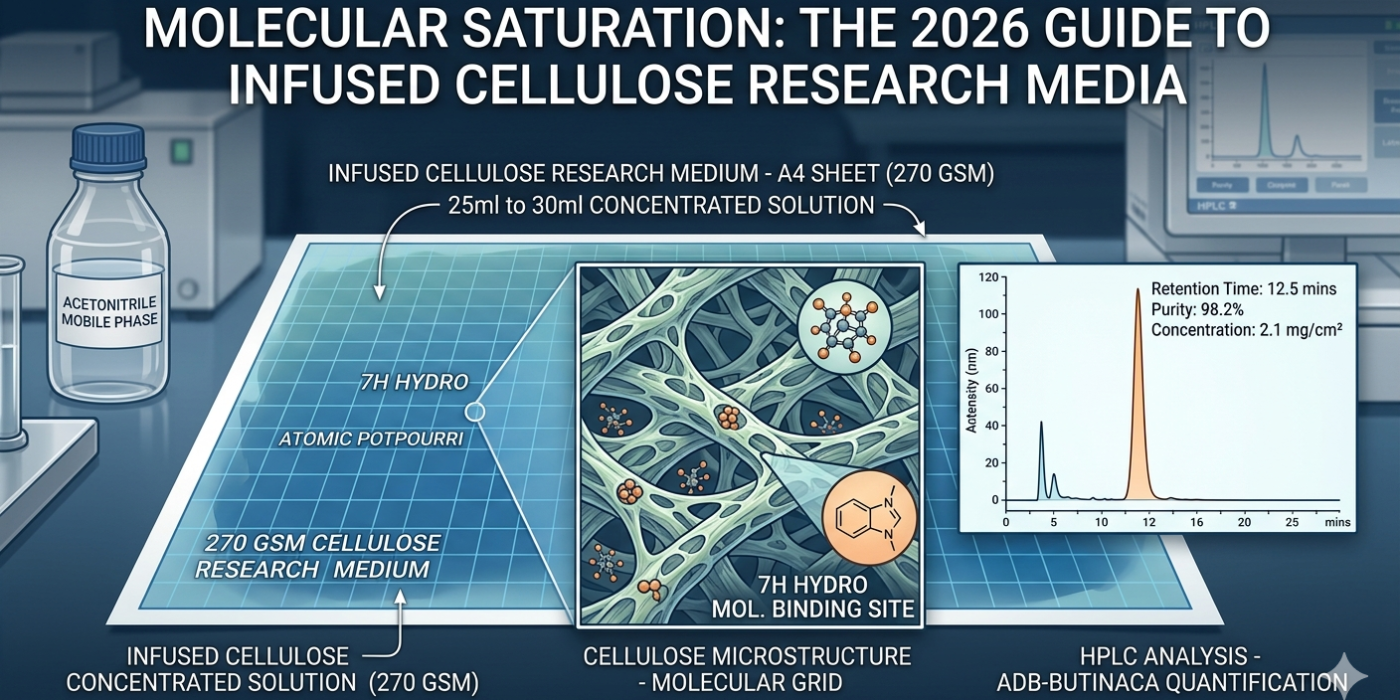
Molecular Saturation: The 2026 Guide to Infused Cellulose Research Media
The Physical Chemistry of Cellulose Substrates
Cellulose serves as the primary backbone for modern infused research media. This organic polymer consists of long, linear chains of glucose molecules. These chains create a porous, three-dimensional grid at the microscopic level. Scientists value this structure for its remarkable surface area and bonding potential.
Researchers prioritize cellulose because it offers an immense surface area for molecular binding. In 2026, the industry standard for high-end research is 270 GSM (Grams per Square Meter). This specific weight provides the ideal balance between liquid absorption and structural integrity.
Thinner paper often tears during the high-pressure saturation process. Such failures waste expensive chemical analogs and halt laboratory progress. Conversely, thicker boards might trap the chemical too deeply for effective analysis. The 270 GSM “Sweet Spot” ensures the analog remains accessible for thermal desorption studies.
This weight also maintains a consistent fiber density across the entire sheet. This consistency prevents “pooling” during the drying phase of production. Proper cellulose selection is the first step in high-fidelity neurological mapping. For the full chemical theory, see our The 2026 Guide to Neuro-Research: Understanding Psychedelic Analogs and Chemical Safety
Solvent Selection and the Saturation Curve
The Research Chemical Definition emphasizes the stability of the final laboratory product. To achieve this, chemists must choose the correct solvent for the infusion process. The solvent acts as the vehicle for the synthetic analog.
- Acetone: This solvent evaporates rapidly. However, it often leaves “hot spots” of concentrated chemicals on the paper surface. These patches create uneven dosing across the research medium.
- Ethanol (95%): Ethanol provides a superior, even distribution of the analog across the cellulose fibers. It penetrates the core of the paper more slowly than acetone. This slower rate allows for a more uniform molecular coating.
- Propylene Glycol (PG): Technicians add PG to act as a humectant. It keeps the paper flexible and prevents the chemical from flaking off during handling. Without PG, the infused paper becomes brittle and loses its active potency.
Scientists calculate the Saturation Curve before processing every batch. This curve identifies the maximum liquid volume the paper can hold. For a standard A4 sheet, this volume usually falls between 25ml and 30ml.
Over-saturation leads to a phenomenon called “bleeding.” In this state, the chemical pools at the edges of the card stock. This creates inconsistent data for the researcher and ruins the experimental parameters.
Molecular Locking: How Analogs Bind to Paper
When the solvent evaporates, the synthetic cannabinoid molecules remain behind. They nestle into the microscopic voids of the cellulose grid. This physical entrapment is only the beginning of the binding process.
- Van der Waals Forces: These weak intermolecular forces hold non-polar cannabinoids to the paper fibers. They function like microscopic magnets at the atomic level.
- Hydrogen Bonding: Analogs with hydroxyl or amine groups form stronger bonds with the cellulose. These bonds prevent the chemical from migrating or “leaking” out of the paper. Buy Tirzepatide 40mg
This “locking” mechanism is vital for Harm Reduction in the laboratory. It ensures a consistent dose across every square inch of the paper. Without a uniform grid, forensic data becomes unreliable and potentially dangerous. Researchers rely on this uniformity to map receptor affinity with surgical precision.
The 2026 Infusion Methodology: Spray vs. Vacuum
Two primary methods dominate the 2026 market: Industrial Spraying and Vacuum Dipping.
- Industrial Spraying: High-pressure nozzles atomize the liquid into a fine mist. This mist settles evenly across the 27×39 card stock. This method is the “Gold Standard” for large-format sheets. It maximizes atom economy and minimizes chemical waste during production. Buy K2 Spice Paper Online
- Vacuum Dipping: Technicians place the paper in a vacuum chamber with the liquid. They remove the air to force the liquid into every fiber. This ensures the highest possible potency for “Full Agonist” research. Vacuum dipping removes oxygen, which prevents early chemical degradation.
Forensic Verification and “How to Test” Infused Media
Section 5 of our main guide explains how to test research chemicals. On a paper substrate, this requires specialized steps to ensure data integrity.
- UV-Induced Fluorescence: Most synthetic analogs glow under 365nm UV light. Researchers scan the paper for a uniform glow. Dark patches indicate “cold spots” with no active chemical. This provides a fast, non-destructive quality control check.
- Micro-Extraction: Analysts cut a square from the sheet. They wash the sample in a small vial of methanol. This solvent “washes” the chemical off the paper for liquid analysis. This step is mandatory for high-resolution mass spectrometry.
- Reagent Reaction: The resulting methanol solution reacts to the Marquis Reagent. A sharp color shift confirms the presence of the specific chemical family. This verifies that the brand on the label matches the chemistry in the fibers.
Thermal Desorption and Aerosolization Studies
Researchers often study how these chemicals behave when they face heat. This process is called Thermal Desorption. It allows scientists to study the vaporized phase of the analog.
- The Heat Source: Labs use a controlled heating element set to 180°C. This temperature effectively releases most synthetic cannabinoid analogs without destroying them.
- Phase Change: The solid analog on the paper turns into a gas. The cellulose substrate remains solid and stable during this phase.
- Analysis: A mass spectrometer captures this gas. It then measures the “Aerosolized Potency” for forensic mapping and safety data.
This research helps scientists understand how these chemicals interact with biological systems. It provides the data needed for emergency rooms to treat accidental exposures. It also assists in designing safer laboratory ventilation systems for 2026.
Environmental Impact and “Green” Infusion
Section 12 of the main guide highlights Environmental Sustainability. In this sub-post, we examine Green Solvents. These choices protect the planet and the researcher simultaneously.
- Supercritical : High-end labs now use as a solvent. It leaves zero toxic residue on the research paper. This method represents the pinnacle of “Clean Research” in 2026.
- Biodegradable Substrates: We are currently testing hemp-based papers. These fibers offer even higher absorption rates for synthetic liquids. Hemp is a more sustainable resource than traditional wood-pulp paper.
Storage for Long-Term Structural Integrity
The “Four Enemies” from our main guide also apply to infused media. Improper storage ruins the integrity of the research sample and leads to skewed results.
- Oxidation: Air exposure can turn the paper yellow. This process slowly degrades the K2 analog over time. Always store samples in vacuum-sealed containers to prevent air contact.
- UV Light: Sun exposure breaks the chemical bonds of the synthetic compound. Store all samples in a completely dark environment. Even brief exposure to light can reduce potency by 10% or more.
- The Storage Solution: Store all infused paper in Mylar bags with oxygen absorbers. Keep these bags in a cool, dark environment at 18°C. This temperature maintains molecular stability for long-term archiving.
Advanced Mathematical Modeling for Dosing
Precision is the heart of the Cluster project. Researchers must calculate the exact milligrams per square centimeter ().
- The Formula: Divide the total mass of the analog by the total area of the sheet.
- Precision: High-quality infused paper typically aims for 1mg to 5mg per square centimeter.
- Error Correction: Analysts check multiple sections of the sheet to ensure a low variance. A variance of less than 3% is the 2026 laboratory standard.
Legal Context: Infused Media and the Analog Act
Authorities view infused paper differently than bulk powder. In many regions, the paper itself may fall under “Drug Paraphernalia” laws. This increases the legal complexity for the researcher.
- The Intent Clause: Sellers must label these products “Not for Human Consumption.” This label is a critical legal shield for legitimate chemical sales.
- Customs Issues: Large sheets of paper are harder for sensors to detect than powders. This makes them a high-risk category for international shipping and customs scrutiny.
The Future of Infused Research
Infused media represents the peak of Precision Dosing in 2026. By combining organic chemistry with paper physics, we create a stable research tool. This allows for the safe and accurate mapping of receptor sites.
Quantifying Potency: The HPLC Extraction Protocol
In 2026, researchers must move beyond simple reagent tests to ensure data integrity. HPLC allows for the exact quantification of the analog trapped within the paper fibers.
-
Sample Preparation: Analysts remove a precise disk from the center of the 270 GSM sheet. They place this disk into a specialized HPLC vial.
-
The Solvent Phase: Researchers add a “Mobile Phase” liquid, usually a mixture of Acetonitrile and Water. This liquid draws the synthetic molecules out of the cellulose grid.
-
Sonication: The vial undergoes ultrasonic vibration for 15 minutes. This process breaks the Van der Waals forces mentioned in Section 3.
-
The Column Run: The machine pushes the liquid through a silica-packed column. Different molecules travel at different speeds. This allows the lab to identify the primary analog and any trace impurities.
Interpreting the Chromatogram
A clean research sample produces a single, sharp peak on the HPLC graph.
-
Retention Time: This tells the researcher exactly which molecule is present (e.g., 7H Hydro vs. Atomic).
-
Peak Area: The size of the peak corresponds to the concentration of the chemical.
-
Purity Standards: In 2026, a “Research Grade” infused paper must show 98% purity or higher. Anything less indicates a flawed infusion process or degraded starting material.
The Research Chemical Definition is not just about the molecule. It is about the precision of the medium. By mastering the science of Infused Cellulose Research Media, laboratories can ensure their findings are reproducible and safe. This technical foundation supports every other category in the Cluster, from stimulants to dissociatives.