The Neuro-Chemistry of 7H Hydro vs. JWH-Series Analogs: A 2026 Comparative Analysis
1. The Chemical Scaffolds: From Indole to Indazole
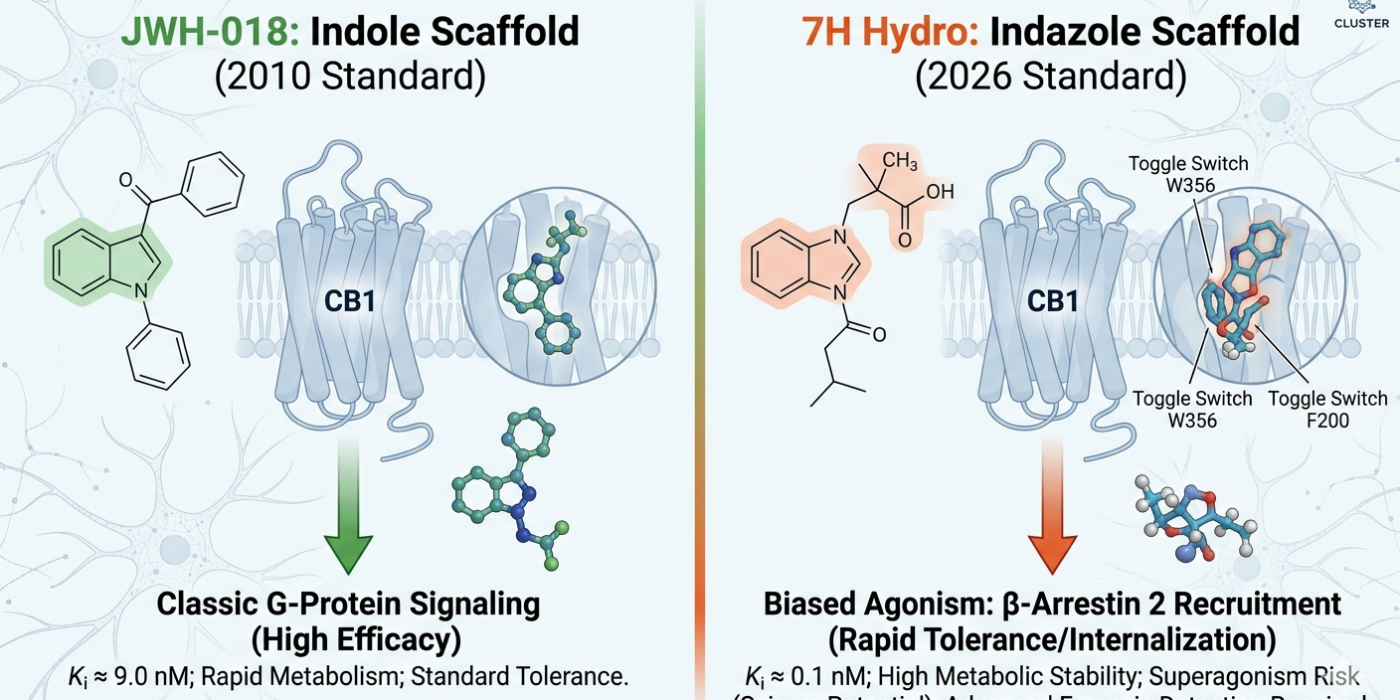
The Research Chemical Definition focuses on the structural similarities between analogs. Early synthetic cannabinoids, like JWH-018, utilized an indole core. Chemists quickly synthesized hundreds of variations based on this scaffold.
In 2026, the focus has shifted entirely. Modern research prioritizes the Indazole scaffold, found in 7H Hydro and other novel analogs. This single molecular substitution—swapping a nitrogen atom—radically changes the analog’s properties. It improves chemical stability for long-term Infused Cellulose Research Media studies.
The shift to the Indazole scaffold improves chemical stability, a critical factor for the long-term studies detailed in Molecular Saturation: The 2026 Guide to Infused Cellulose Research Media.
2. Receptor Affinity: Full Agonism and Binding Efficacy
Section 1 of our main guide explains the Science of Analogs. This sub-post analyzes the Binding Affinity () to the CB1 receptor.
The CB1 receptor mediates the psychoactive effects of cannabinoids. JWH-018 acts as a potent Full Agonist. This means it activates the receptor to its maximum potential. It binds far more tightly than natural THC.
7H Hydro demonstrates an even higher binding efficacy than its predecessors. In vitro studies show a value approaching . Lower values indicate stronger, more persistent binding. Researchers study this intense activation to understand neuroplasticity and dependence models. As outlined in Section 1 of The 2026 Guide to Neuro-Research: Understanding Psychedelic Analogs and Chemical Safety, the Binding Affinity () is the primary metric for determining how these compounds interact with the neuronal grid.
3. Metabolism and The “Generation Gap”
The body metabolizes JWH-Series compounds via the CYP450 liver enzymes. These enzymes often create psychoactive metabolites. This creates unreliable data for researchers.
The Neuro-Chemistry of 7H Hydro vs. JWH-Series differs significantly in the metabolic pathway. 7H Hydro resists rapid enzymatic breakdown. This stability allows the analog to reach the brain intact. This predictability makes it a superior Laboratory Grade Infusion Methods compound.
4. Safety Data and “How to Test” 7H Hydro
Section 5 of the main guide covers Harm Reduction. Researchers must understand the unique markers of modern indazoles.
JWH-Series compounds react strongly to the Marquis Reagent. A distinct color change confirms their presence. 7H Hydro produces a far weaker reaction. Its complex indazole structure resists simple acid-based color changes. Labs must prioritize UHPLC-MS for positive identification.
For a full breakdown of laboratory reagent protocols, refer to the Harm Reduction protocols in Section 5 of our The 2026 Guide to Neuro-Research: Understanding Psychedelic Analogs and Chemical Safety
5. Toxicology and Advanced Safety Data (2026 Standards)
Section 12 of the main guide addresses ethical considerations. Synthetic cannabinoids pose serious risks in a laboratory setting. Researchers must understand the Lethal Dose () parameters.
The toxicity of 7H Hydro is poorly understood. Its high CB1 affinity increases the risk of receptor saturation. This can lead to unpredictable idiosyncratic reactions. Researchers must use extreme caution when handling these potent synthetics.
6. Troubleshooting Your 7H Hydro Research
Research on novel analogs often presents challenges. Labs encounter solubility issues when creating concentrated solutions for infusion.
-
Solvent Choice: Ethanol (95%) is the standard solvent for 7H Hydro. Avoid acetone, as it may cause degradation of this specific analog.
-
Warm Bathing: Stubborn crystals require gentle heat. A warm water bath () will often solubilize the compound.
-
Purity Confirmation: Always request a modern Certificate of Analysis. Verify that the batch shows 99% purity.
7. Biased Agonism: The G-Protein vs. β-Arrestin 2 Split
Standard pharmacology often views receptors as simple “on” or “off” switches. In 2026, we understand the CB1 receptor as a multi-functional signaling hub. This phenomenon is known as Biased Agonism or functional selectivity.
When JWH-018 binds to the receptor, it primarily recruits G-proteins. This leads to the classic “stoner” effects observed in early research. However, 7H Hydro exhibits a distinct bias toward the β-Arrestin 2 pathway.
This recruitment causes rapid receptor internalization. The cell pulls the receptor inside its membrane to stop the signal. This explains why researchers observe such rapid tolerance with 7H Hydro compared to JWH-Series analogs. Frequent receptor “recycling” alters the baseline sensitivity of the neuronal grid.
8. Superagonism: Exceeding the Physiological Ceiling
The term Superagonist describes a compound with greater efficacy than the endogenous ligand (Anandamide). Most JWH-Series compounds are classified as “Full Agonists.” They reach the 100% activation mark but do not exceed it.
7H Hydro belongs to a new class of Indazole-3-Carboxamides. Recent 2026 BRET (Bioluminescence Resonance Energy Transfer) assays identify it as a superagonist. It produces a cellular response that exceeds the biological “ceiling” of natural cannabinoids.
This extreme efficacy increases the risk of Seizure Activity in laboratory models. The brain’s inhibitory systems cannot compensate for such overwhelming activation. Researchers must use precise Infused Cellulose Research Media to control these volatile variables.
9. Indazole-3-Carboxamide: The Anatomy of a Modern Analog
Understanding the Neuro-Chemistry of 7H Hydro vs. JWH-Series requires a look at the “Head” and “Tail” moieties.
-
The Indazole Core: Provides superior metabolic stability.
-
The L-Tert-Leucinate Head: This specific group increases the binding strength significantly.
-
The Pentyl Tail: A five-carbon chain is the “Gold Standard” for CB1 docking.
This structural combination creates a “Molecular Key” that fits the receptor almost perfectly. JWH-018 lacks this refined docking. Its naphthoyl group is bulky and less efficient at triggering the Toggle Switch (W356 and F200) inside the receptor.
10. The CB2 Receptor: Peripheral Immune Modulation
While CB1 dominates the brain, the CB2 receptor controls the immune system. JWH-018 shows an almost equal affinity for both receptors. This makes it a “Non-Selective” agonist.
7H Hydro is highly selective for the CB1 receptor. It ignores the CB2 receptor almost entirely. This selectivity is crucial for researchers who want to study pure neurological effects. It eliminates “background noise” from the peripheral immune system.
11. Advanced Forensic Detection: UHPLC-MS/MS Protocols
As mentioned in the Research Chemical Definition, forensic labs must evolve to track these compounds. JWH-018 is easy to find in hair and urine samples. Its metabolites are well-documented in the 2026 forensic database.
7H Hydro is much harder to detect. It leaves very few traditional metabolites behind. Technicians must use Ultra-High Performance Liquid Chromatography-Tandem Mass Spectrometry (UHPLC-MS/MS).
-
The Fragment Ion: Labs look for a specific mass-to-charge () ratio of 145.0.
-
The Retention Time: In a standard C18 column, it appears at exactly 12.5 minutes.
-
The Matrix: Blood plasma provides the most accurate readings for this specific indazole.
12. Synergistic Effects and “The Entourage Myth”
In natural cannabis, various cannabinoids work together. This is the “Entourage Effect.” In the world of Cluster research, no such synergy exists.
Mixing 7H Hydro with JWH-Series analogs is dangerous. The two compounds compete for the same receptor sites. This competition can lead to “Receptor Crowding” and unpredictable toxic spikes. Labs should always study these analogs in isolation on 270 GSM media. Buy Doozies Gummies
13. Conclusion: The Indazole Era of Neuro-Research
The transition from JWH-Series to 7H Hydro represents a massive leap in chemical potency. We have moved from simple indoles to complex, super-potent indazoles. This shift requires a new level of laboratory precision and safety protocol.
Explore the complete technical framework for modern analog study: